Showing posts with label mining. Show all posts

Wednesday, July 4, 2012

Mexico Stories: Part II

5.
 
The sun was born of a dry landscape. Today, perhaps because the Wirikuta reserve in San Luis de Potosi is its birthplace, the sun illuminates Wirikuta’s matte hillsides with the most tender glow and sets upon the desert floor in a most slow surrender. 
Wirikuta’s nooks and crannies and shrub-covered undulations give refuge to towns – they are carved into hillsides, or superimposed upon them, or else houses appear like scattered matchsticks without ever gathering into something that could be called ‘town.’ Underneath the carpet of the ground is another city, that of old mine shafts and galleries big as ballrooms carved into the rock below: silver. 
There are churches above and below the low shrubbery, and both catered to the miner. In the one above, the floors are made of what looks like the sidewalls of cedar chests; the patron saint is San Francis de Assisi. The one below is dark, the little altar illuminated only when headlamps fall upon the stone in spots. Doesn’t that make prayer somehow more personal? 
 
In an abandoned mine site below Real de Catorce, the altar was the only thing with any visible upkeep. The wooden portals and massive stone walls of the wearing buildings were not attended to. Water flowed out of the mine mouth; we ventured into its velvet throat to cool off from the heat, then napped on logs. The resident cat led us to a man that used to mine here. I mined all over, he told us, but came back here, because this is where I am from. Cats leave home to die, men come home. 


Monday, May 31, 2010

The Mine is Fea: Meet Carlos and Carlos

Meet Carlos:

"You know," says Carlos, "I never used to work with clothes on." He's handsome, though downtrodden, and I could see why every tourist Wily brought down to where his group, The Sanchez, worked took home a picture of his shirtless torso glistening in the orange light of the work lamps. The Señoras palliris that we're sitting with squint against the sun and one of them asks, "What was it?"

"Gas," says Carlos, "I saw a ton of colors, all matter of colors, and then I don't remember."

He was dragged out of the depths of the mine by his legs about a year and a half ago, by another miner; dead, according to him, but I don't know if that means he was unconscious or really dead or...After recovering he got a post with the government, guarding the now-defunct COMIBOL processing plant, where he and two other men patrol the massive skeleton of what was Bolivia's mining glory during the short run of reform and nationalization from 1952 to 1985, when mineral prices crashed and the plant shut down permanently.

"We communicate with whistles," he says of the other two men. And later, walking in the sun dappled ruins of the various building he shows me parts that have been robbed and insists, with perhaps misinformed Bolivian optimism, that the plant could definitely work and still has up to date technology - American and Czech! - to process the low-grade mineral coming out of the mines now. The plant itself is not unlike sugar processing mills and gypsum factories I've snuck into - rubber transport belts running between corrugated sided building with missing wooden planks in the floors and stopped machinery, some with remnants of the last load that ever made its way through it, still present.

In the guards' office, he brings me samples of the minerals from the Cerro Rico and we talk about math under posters of callipygian white women. He scribbles a formula on an index card for me - 10√hxd - and draws an arc with twelve little crosses, indicating where the dynamite would go around a vein, to open it up. The accident made him more courageous, he says, but the new job is asegurado; he's salaried and he gets retirement pension. Too, he doesn't explain what long term damage the accident has had on him but says, meekly, "This job, pure laziness. Now, when my wife asks me to help her bring water 'I'm mal [bad]', I tell her."

Meet another Carlos:

Outside of church, Carlos Sanchez Flores' mother stood in the middle of an intersection directing service goers to the rented salon up the way. She wore all black, full knee-length skirts and slips blowing up to reveal that her stockings, too, ended at her knee, and the wind caught the length of thin fabric she had wrapped around her head and torso and floated it, a gracefully amorphous but threatening cape that enveloped and thrashed at each person that approached her. The sky was a soft, voluminous grey and the leaves in the courtyard of the church rustled irregularly. I watched, mesmerized, until Don Juan led me away by the elbow, whispering softly, "And, Señorita, how are you this morning? How cold! No? Did you know the friend?"

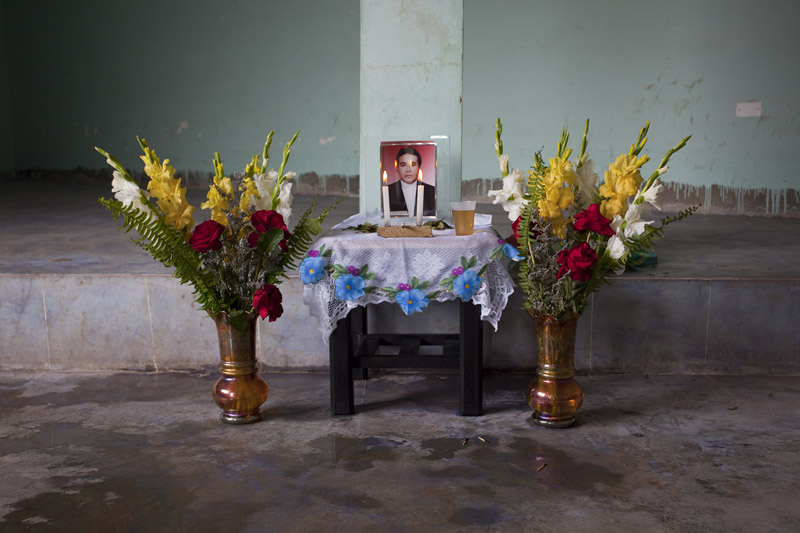
Carlos Sanchez Flores died a year ago, of gas in the mine, and there was going to be a big party. "It is because his soul has gone lightly, now," explains Marlene. In a turquoise, scrubbed room, we sat along the walls and received his mother and sisters, who walked around handing out cigarettes and distributing palm-fulls of coca leaves. A picture of Carlos along with all necessary libations plus candles stood at one end of the room and his mother sat by it, smoking, backlit by the engraved windows, and proclaimed definitively through the fog, "Drink!"

Don Juan, cat-like, exhaled at me, "Come back at 5. We will dance."

In the evening, the family had changed out of their black grieving clothing, which they had worn all year, and sat in a line against the wall with confetti in their hair, receiving guests. Guests came, kissed them on each cheek and pinned bills on the lapels and scarves of chosen members. Speakers as big as dog houses were piled up on both sides of the room and a live band recreated songs that would have sounded much better had they been played from a CD.

Drinks were first brought out on little fish trays; each tray contained a rum mixed drink, a sangani glass and two small shots of 96% alcohol mixed with something. Then waiters made their rounds with beer. Then more fish trays. Then large silver trays of just shots with another waiter trailing behind with a tray to deposit empties. Mother and sisters walked around restlessly, foreheads wrinkled with worry, waving both hands palms up, as if soliciting louder applause, and pleading, "Drink, drink!" Bottles appeared and their owners, too, made rounds distributing shots, waiting for you to take yours before ambling along. "I am sick," I tried to explain. "This is 96% alcohol. It will cure you," they insisted.

The dancing was getting sloppier and sloppier and I sat through a 15 minute "conversation" about Arnold Schwarzenegger; the only reason I knew it was still about Schwarzenegger was because the monologuer paused intermittently and slurred out, "Schwaaaaaaarzeneggerrrrr, you knoooow him?" as clearly as he could before continuing on with it. When I started getting aggravated, Johnny, ever helpful, leaned over and said, "Here, one must get along with everyone."

Carlos, I'm told, was rich and also powerful within the mine. The group of which he was the boss, The Sanchez, was the same one that the other Carlos worked in. Three other men, too, died last year from the same group and it disbanded, fearing the ominous (and carried out) deaths of fellow miners. The deaths, some say, were inevitable. With mineral prices at record highs in decades, the miners were working the veins 24-hours a day - day and night shifts - and drinking heavily (see above) in their off time. The mine never ventilated, allowing gas to accumulate, and their bodies never rested, lessening any chance of withstanding an onslaught of gas. Too, The Sanchez worked deep down, aggravating all of the above conditions until they fulfilled fatally, four times over.

There were no speeches and little mention of why we were there. There was a lot of drinking and dancing and then, again in our seats lining the turquoise walls, we ate pig and potatoes with our fingers from overloaded bowls while discussing sports.

"Asi es la mineria," Don Juan had said when he led me away that morning, which seemed melancholy, at best. But Johnny, drunk in a house discotheque later that night, explained: "I do not cry always (though his eyes were moist under the black lights), but here, it hurts very much," he said, pointing to his heart and making a movement with his hands as if his heart was vomiting. Then he grabbed me and we danced a strange stomping dance to a song from Oruro.

Saturday, May 15, 2010

Meet don Pablo

don Pablo looking at mineral with Pablito in the background.

Don Pablo, about 300-pounds heavy just up top with short skinny legs and tiny feet, seemed grotesque at first. When I met him he was sitting, his little legs splayed open to leave room for his three-tiered belly, and chewing coca. Leaves stuck to his lips and green saliva flew out whenever he opened his mouth to let out an enthusiastic chortle.

"Come," he said.

I followed him into the tunnel. He lumbered along unhurriedly and then turned off sharply and began to climb. His giant behind loomed as I followed him up a narrow and steep rabbit hole that squeezed around him as if he was carving it as he went. It ended in a wooden slatted door. Everything beyond the door seemed like a kingdom of sorts: dank, narrow corridors that opened up into high chambers, recently opened, small nooks with arched entryways, serpentine passages between levels and amongst galleries, glittering veins snaking through dull grey rock, piles of angled debris blocking passage, heaps of mineral awaiting transport, glittering with silver in the absolute darkness every time my circle of blue light landed on them.

Don Pablo led me through his Coliseum, as he called it, and pointed out all of the new veins; veins waiting to be opened and taken, veins of chocolate, and la negra, veins of pure silver that are handled manually and sold separately in small sacks, veins of complejo - silver and zinc - that are often signaled by the presence of pyrite. Some appear as thin rivulets meeting into wider streams in the damp rock, others like oxidized banners unfurling widely on the roofs of don Pablo's galleries. He throws a small bottle-cap-full of 96% booze on a new vein, to bless it, and admires it with a sort of ache in his voice, "Pucha, que linda es la plata." With him I stand and admire the brilliance of the vein, like the wing of a bird caught still by a gray mass. I think, for the first time, I understand the greed of a prospector, the avaricious eye that sparks at the glint of mineral and that which it promises. Pucha, que linda es la plata. And que fea, too.
Orphaned at age 10, don Pablo began working in the mines with an uncle the same year. Now 50, he has ten kids of his own, the "black sheep" of which, Pablito, 16, works alongside him.

don Pablo, left, and Pablito.

Yesterday, don Pablo went to the doctor.

"You're healthy," the doctor told him.

"Pucha," says done Pablo, "at this rate I'll never retire."

The sector he currently works was worked by COMIBOL, the Bolivian Mining Corporation, when the mines were nationalized, between 1952 and the 1980s. "People told me there's nothing left here," he says, "but I know there is." He perforates to the east and west with Chinese-made pneumatic drills, looking for the veins that run north-south. As we're standing on the top level of his cave, admiring veins, explosions start to go off, like heavy objects falling far away. He counts 16 detonations and then it goes quiet again.

"What if one doesn't go off?" I ask him.

"You come back in 24 hours."

"And?"

He sort of half-shrugs and leads me to another vein. "What I need is peons," he says. "There's too much work." He needs money for explosives, too, so he can release the veins he keeps showing me.

When we're sitting, resting, he says: "What I really wanted to do was be a veterinarian."

Tuesday, May 4, 2010

I'm in Potosi, yo!

From the beginning?

Lima:
5pm traffic in Lima is the worst. My cab driver, one pant leg rolled fastidiously up to his thigh, maneuvered slowly between cars, street-sellers (need an atlas, book on dinosaurs, cell phone charger, snacks? Shop while you're in traffic!) and teenagers to where all the separate bus terminals for each company are concentrated, in La Victoria. Lima-to-Cusco-hour had passed so he took me to a "secure hostel" nearby, "the only secure one in this neighborhood, which is not so good." Thanks, dude! I overpaid at the counter and spent all night and morning listening to people have sex while reclining against my own mirrored headboard, watching bad movies. The securest hostel in town provides condoms along with packets of shampoo and soap.

The Bus:
Few folks have cars so if you want to get somewhere you take a bus. Everyone takes the bus - the lady with the ton of bags and babies, the man with the large mustache, the tourists, the soldiers. Now the buses have stewardesses and security videos like the airplanes and class difference can now be recognized by how far the seat in your bus reclines. You cannot, however, take a poo on the bus. The stewardess on the PA system says, "Please, ladies and gentlemen, remember that the bus's hygiene equipments is only for urinating. If you have other needs please inform me and we will make other arrangements." Not that I do that or anything, because I'm a lady.

Cusco:
Firstly, it looks like this:

I dare you to criticize my love of it now.

All the hippies are always talking about "Cusco's magic," which I will not recognize here, but the city's got damn good light. It's all colonial building, with giant Inca-built walls, and clay roofs that are veritably luminescent in the morning and golden hours. At night, the plaza glows with orange light, reflecting off the grey, smoothed stones that line the plaza. Above the city, eucalyptus and pine grow, almost exclusively, so it smells good, too. C., who's an architect, says what makes it so beautiful is the fifth dimension. When we evaluate a building or buildings amassed together we judge by what we can see, which is usually, at its most basic, the four walls or sides of a structure and their intra-play with each other and interplay with their surroundings. Hilly places, like Valparaiso and Cusco, let a viewer see the fifth wall - the roof. And in Cusco, the roofs are like a rippling, orange sea of ceramic tile bobbing with the height of houses and hills.

It's a strange place. Traveling women are always bringing home husbands and babies from Cusco while local men who don't make it abroad seem to become drug addicts, booze hounds, hippies or a combination of the three. I'm not sure what happens to the women because my interaction with them has been limited to a boozy lady hippy and my Peruvian Ma, who defies all categories. Its mysticism also manifests itself in faux-shamanism; this I wrote about once and will post shortly. More than anything, though, Cusco is almost defined by its tourism. When Machu Picchu closed due to massive rainfall in January, the entire city shut down, forcing hundreds into unpaid "vacations," because it was so empty. Tourists often turn into denizens, about which I also wrote once, and maybe will post as well. While everyone kind of does their own thing during the day, at night the main plaza, orange and glowing, like I said, is ambushed by fun-seekers. If you are white or at least foreign-looking, young Peruvians will chase you around the plaza with flyers offering "free drink, meess, free drink" and asking "where you from, meess, Efrance?" The same electronic remixes will blare from intricately carved balcony windows around the plaza, young children will offer you cigarettes at 2am, a Peruvian will ask you for your email address after you refuse to dance with him, another Peruvian will deny you entrance into his club because you are trying to bring in a brown friend (i.e. Peruvian) rather than a white one, some ladies will inevitably dance on the bar for the first time in their lives (omg, travel is so crazy, guys!), and when the sun starts to rise there will be a drunk-burger exodus. Sometimes you'll get something stolen or get beaten by the cops or go to a metal bar or campfire but mostly this will repeat every night. I think I'm over that part of Cusco, but I did manage to drink it up amply regardless.

my Peru ma:

My First Bullfight:
It may be because there are not enough bulls to go around or because Peru retains an assiduous amateurishness when copying allochthonous cultures, but here, in Cusco, they do not kill the bulls during the running of the bulls. They do, however, send subtly effeminate macho men and shy macha girls into the ring with red and fuchsia capes to piss the bulls off and make them charge at the toreros with salivating menace. It is so exhilarating. I kept forgetting to breath and to drink my beer and to mind my manners. Too, for the first time, I experienced the thrill of machismo rather than being disgusted by it. A regality, of sorts, a presence unnervingly imperial, but innately so - the posture, stance, wide arc of arm movements, deep bows, terrifying yet fearless confrontations with the beasts. I kept staring down an Argentine torero so hard that C. made me go talk to him and G. bowed profoundly and kissed my hand upon introduction. Just like a torero, right?!

A 16-year-old torero:

After the bulls get tucked back into the truck, the people dance!


Hello, Bolivia:
I dreaded it. I mean, it's just such a mess. I took a bus from Cusco to La Paz - about 400 miles - and it took 13 hours. I peed behind a smelly adobe house mid-way with the stars hanging heavy and the exhaust, even out in the country, ripe. Immigration was a cement room with graffiti. "Immigration" was misspelled. At around 9am, dust creeping through the shut windows into the bus, we veered off the paved road and on to a dry, trash-strewn plain with oases of brown puddles. For the next two hours, approaching the largest city in the country, with a population of about 1 million, we, along with many other vehicles, maneuvered the plain at the alarming speed of about 15mph. It's like if one had to approach New York through the marshes. The bus would tip deeply at bumps and get stuck in puddles and have to back up at traffic jams (traffic on the plain!!). I was kind of hoping the bus, full of gringos, was just detouring to see what they could get out of us. Nope, that's just how you get to La Paz.

Aaaaand I'm here! Potosi:
I'm here to shoot photos of miners of the Cerro Rico, Rich Hill. Sitting in my room earlier, I kept hearing explosions and gun shots. It didn't seem odd until I became conscious of it and then it was like, "I'm hearing explosions and gun shots!"

"Oh, there's a march," says the Boliviana doing laundry. Of course.

May 1st just passed and the entirety of salaried Bolivia is currently on strike. The factory workers are 8 days deep into their hunger strike and some other workers are literally sewing their lips shut. The problem: the yearly salary increase this year, as mandated by Morales, is only 5%, which workers say does not make their unlivable wages any more livable.

I rushed out to see what was going on and found a bunch of hard hats amid smoke. Fuck! I'm here to shoot working miners and the miners are on strike. "We will not back down," said the man on the megaphone.

Turns out, though, Potosi is still in commission. The reason? Oh, because salary increases don't apply here - there are no salaries! (Here, miners either make commission or are given a day where they work for themselves rather than their boss or co-op.) The marching miners were from the Porco mine, which is Swiss (I think, might be Swedish) operated and does provide salaries. Good thing you're already screwed to the max, Potosi.

Wednesday, January 6, 2010

Help Fund Potosi, Bolivia Miners: 5 Centuries Deep

Below is an excerpt from a longer proposal I wrote for the same project, Potosi, Bolivia Miners: 5 Centuries Deep, which I recently posted on KickStarter. I'm trying to raise funds to get this project going, so if you know anyone who may be interested, with some change to spare, spread the word! thanks!

Here is a photo with a miner, taken by my friend Josie, in 2005:


In 2006, I turned in my undergraduate Environmental Science thesis predicting certain doom for the communities that live around the Cerro Rico mine in Potosi, Bolivia. One of my sources predicted that the mine, functioning continuously since 1542, will finally be depleted in 10 years. Though this is true only in part – new technology will permit profitable reworking of tailings as well as exploitation of previously untouched deposits – the conical mine with its manual, anthill-like activity of miners will surely grow quieter as less mineral is left to drag out with the crude methods currently used. Potosi, once the richest city in the world, will have to either embrace the tourism that is already exploding in the city or work out a solution with the international companies vying to mine there and once again, take Potosi’s riches abroad.

The mine’s influence over the years – the tangible riches it produced, the intangible glory it brought to Spain – is mostly gone. And the destitute miners who go into the Cerro Rico mine now, fathers, sons and brothers in a long line of men, may be the generation that will see the mine breathe its last. I want to photograph this particular generation of Cerro Rico miners, possibly the final.

I want the documentation of the miners and the mining community to be threefold – 1.) documentary-style photography of the men in the mines and of the community in general, 2.) formal, black and white portraits, and 3.) to establish a camera distribution so community members can take photos of each other/themselves. The first, I think, is important to show that this place exists, that it exists in this way in the 21st century, and to reveal what happens there, the texture of the place and the people. The second is to give a formality and gravity to the series of images: to take time with a subject, to photograph them head on, to immortalize in the most classic way. The third, which will be the most challenging I believe, is to empower the community to present themselves to the world on their terms – terms to be explored and negotiated with the participating members.

I have been to the Cerro Rico mine twice, both times with Wilfredo Bracamonte, an ex-miner who now gives tours to tourists of the mines. In a recent correspondence he said that he would help me to establish contact with some miners to start off the project, though one mining co-op, the Korimayu, has already extended such an invitation to me. Further, the city is replete with tour guides, many of them ex-miners that I believe I will ask for further assistance once on the ground in Bolivia. Additional routes to explore would be the miners’ market, mining union halls, the mineral processing factories, and to introduce myself to the women who work on the outskirts gleaning bits of mineral by artisanal mining and processing.

I have two personal goals with this project; 1. to document this community and to let them document themselves and 2. to grow as a photographer. The target is to have an exhibit towards the end of the project where both my photos and those taken by community members are displayed for locals and tourists to see in Potosi. I hope to able to incorporate older photos, to be solicited from families or bought in local antique shops, to present a portrait of the city in a historical context, drawing a line between the past and the present and commenting on both the richness of the history and the reality of the present.

I want the project to be ethnographic in methodology, though not strictly academic in scope. Rather, I am interested in reinforcing community and fostering understanding through photography, as well as producing a solid body of photo work. I think this is a particularly relevant time to venture to do this – as mineral reserves in the Cerro Rico wind down and foreign investors start to set up processing centers and operations in and around the mountain to wean profits from poorer ore, the Potosi community will no doubt undergo changes. Martin and Spence (1988), in an essay about photography as therapy, write, “By recording such events [them]selves, particularly by those people who are powerless and marginalized by the dominant stories in circulation a new form of social autobiographical documentation can be put together.”