Lima:
5pm traffic in Lima is the worst. My cab driver, one pant leg rolled fastidiously up to his thigh, maneuvered slowly between cars, street-sellers (need an atlas, book on dinosaurs, cell phone charger, snacks? Shop while you're in traffic!) and teenagers to where all the separate bus terminals for each company are concentrated, in La Victoria. Lima-to-Cusco-hour had passed so he took me to a "secure hostel" nearby, "the only secure one in this neighborhood, which is not so good." Thanks, dude! I overpaid at the counter and spent all night and morning listening to people have sex while reclining against my own mirrored headboard, watching bad movies. The securest hostel in town provides condoms along with packets of shampoo and soap.
The Bus:
Few folks have cars so if you want to get somewhere you take a bus. Everyone takes the bus - the lady with the ton of bags and babies, the man with the large mustache, the tourists, the soldiers. Now the buses have stewardesses and security videos like the airplanes and class difference can now be recognized by how far the seat in your bus reclines. You cannot, however, take a poo on the bus. The stewardess on the PA system says, "Please, ladies and gentlemen, remember that the bus's hygiene equipments is only for urinating. If you have other needs please inform me and we will make other arrangements." Not that I do that or anything, because I'm a lady.
Cusco:
Firstly, it looks like this:


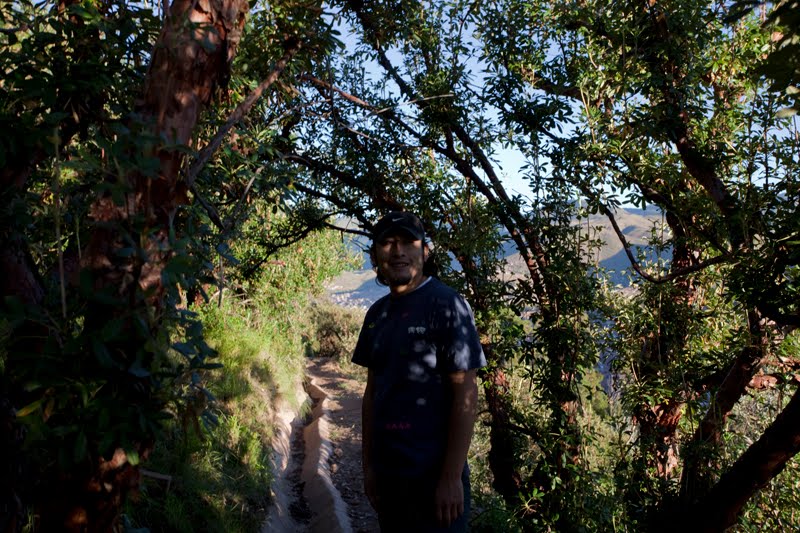 I dare you to criticize my love of it now.
All the hippies are always talking about "Cusco's magic," which I will not recognize here, but the city's got damn good light. It's all colonial building, with giant Inca-built walls, and clay roofs that are veritably luminescent in the morning and golden hours. At night, the plaza glows with orange light, reflecting off the grey, smoothed stones that line the plaza. Above the city, eucalyptus and pine grow, almost exclusively, so it smells good, too. C., who's an architect, says what makes it so beautiful is the fifth dimension. When we evaluate a building or buildings amassed together we judge by what we can see, which is usually, at its most basic, the four walls or sides of a structure and their intra-play with each other and interplay with their surroundings. Hilly places, like Valparaiso and Cusco, let a viewer see the fifth wall - the roof. And in Cusco, the roofs are like a rippling, orange sea of ceramic tile bobbing with the height of houses and hills.
It's a strange place. Traveling women are always bringing home husbands and babies from Cusco while local men who don't make it abroad seem to become drug addicts, booze hounds, hippies or a combination of the three. I'm not sure what happens to the women because my interaction with them has been limited to a boozy lady hippy and my Peruvian Ma, who defies all categories. Its mysticism also manifests itself in faux-shamanism; this I wrote about once and will post shortly. More than anything, though, Cusco is almost defined by its tourism. When Machu Picchu closed due to massive rainfall in January, the entire city shut down, forcing hundreds into unpaid "vacations," because it was so empty. Tourists often turn into denizens, about which I also wrote once, and maybe will post as well. While everyone kind of does their own thing during the day, at night the main plaza, orange and glowing, like I said, is ambushed by fun-seekers. If you are white or at least foreign-looking, young Peruvians will chase you around the plaza with flyers offering "free drink, meess, free drink" and asking "where you from, meess, Efrance?" The same electronic remixes will blare from intricately carved balcony windows around the plaza, young children will offer you cigarettes at 2am, a Peruvian will ask you for your email address after you refuse to dance with him, another Peruvian will deny you entrance into his club because you are trying to bring in a brown friend (i.e. Peruvian) rather than a white one, some ladies will inevitably dance on the bar for the first time in their lives (omg, travel is so crazy, guys!), and when the sun starts to rise there will be a drunk-burger exodus. Sometimes you'll get something stolen or get beaten by the cops or go to a metal bar or campfire but mostly this will repeat every night. I think I'm over that part of Cusco, but I did manage to drink it up amply regardless.
my Peru ma:

My First Bullfight:
It may be because there are not enough bulls to go around or because Peru retains an assiduous amateurishness when copying allochthonous cultures, but here, in Cusco, they do not kill the bulls during the running of the bulls. They do, however, send subtly effeminate macho men and shy macha girls into the ring with red and fuchsia capes to piss the bulls off and make them charge at the toreros with salivating menace. It is so exhilarating. I kept forgetting to breath and to drink my beer and to mind my manners. Too, for the first time, I experienced the thrill of machismo rather than being disgusted by it. A regality, of sorts, a presence unnervingly imperial, but innately so - the posture, stance, wide arc of arm movements, deep bows, terrifying yet fearless confrontations with the beasts. I kept staring down an Argentine torero so hard that C. made me go talk to him and G. bowed profoundly and kissed my hand upon introduction. Just like a torero, right?!
A 16-year-old torero:


 After the bulls get tucked back into the truck, the people dance!


Hello, Bolivia:
I dreaded it. I mean, it's just such a mess. I took a bus from Cusco to La Paz - about 400 miles - and it took 13 hours. I peed behind a smelly adobe house mid-way with the stars hanging heavy and the exhaust, even out in the country, ripe. Immigration was a cement room with graffiti. "Immigration" was misspelled. At around 9am, dust creeping through the shut windows into the bus, we veered off the paved road and on to a dry, trash-strewn plain with oases of brown puddles. For the next two hours, approaching the largest city in the country, with a population of about 1 million, we, along with many other vehicles, maneuvered the plain at the alarming speed of about 15mph. It's like if one had to approach New York through the marshes. The bus would tip deeply at bumps and get stuck in puddles and have to back up at traffic jams (traffic on the plain!!). I was kind of hoping the bus, full of gringos, was just detouring to see what they could get out of us. Nope, that's just how you get to La Paz.
Aaaaand I'm here! Potosi:
I'm here to shoot photos of miners of the Cerro Rico, Rich Hill. Sitting in my room earlier, I kept hearing explosions and gun shots. It didn't seem odd until I became conscious of it and then it was like, "I'm hearing explosions and gun shots!"
"Oh, there's a march," says the Boliviana doing laundry. Of course.
May 1st just passed and the entirety of salaried Bolivia is currently on strike. The factory workers are 8 days deep into their hunger strike and some other workers are literally sewing their lips shut. The problem: the yearly salary increase this year, as mandated by Morales, is only 5%, which workers say does not make their unlivable wages any more livable.
 I rushed out to see what was going on and found a bunch of hard hats amid smoke. Fuck! I'm here to shoot working miners and the miners are on strike. "We will not back down," said the man on the megaphone.
 Turns out, though, Potosi is still in commission. The reason? Oh, because salary increases don't apply here - there are no salaries! (Here, miners either make commission or are given a day where they work for themselves rather than their boss or co-op.) The marching miners were from the Porco mine, which is Swiss (I think, might be Swedish) operated and does provide salaries. Good thing you're already screwed to the max, Potosi.