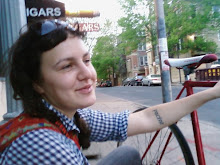
The Center of Mexico City, C. says, is magical. The buildings lean heavily, as if on diabetic swollen legs, as if they might straighten out, but just now are needing to catch their breath. At night, the tunnels of sidewalks seem furbished with funny mirrors, walls jut out here and there at unexpected angles and the burdened bellies of structures expand voluptuously into sidewalk space. Much trash on the dark streets, the residue of day-time markets. Alleys lead to yellow bulbs illuminating crowded courtyards with plastic saints, which many families share amongst themselves; tenements. Unexpectedly, there are ruins, too, inserting themselves into the modern city with a stubbornness that, though worn, is indefatigable. And the Mexicans, they know, they fly kites by the thousands in the Zocalo, push the bright plastic into the sky and tether themselves to reality only by the thinnest strings.
2.
Commerce is segregated and specialized by product. Perhaps it is because Mexico City is so large, its offerings so vast, that stores and markets and shopping streets are grouped by product; Flower Market, Party Decorations Street, Shoe Street, Witches’ Supply Market, Cake Store. As if to make it easier. The effect is overwhelming. Store after store, market-stand after market-stand, offering the same product or various iterations of it. The shoes did not impress much. But a warehouse full of flowers, truck beds loaded up with rosemary ten feet high, gladiolus blooms by the thousands, may have. Outside of the flower market, dozens of men and women sat around in the courtyard weaving crosses out of palm fronds and laughing at each other’s’ jokes.
3.
Something about C. makes me feel Mom-ish, makes me want to dole out warnings, admonitions, safety advice. Though I rarely feel danger imminent to my own self, the danger I feel for others – metaphysical, physical – hovers inside me like a cloud of insects, buzzing, incessantly on the move, the cloud growing and contracting, but mostly expanding outward steadily into a panic attack. C. intensifies this somehow. I said the highway was no way to ride, but I didn’t mind, other than on her behalf.
4.
A famous movie producer’s – from Mexico golden age of cinema – house in Cuernavaca. That name sounds cavernous, but the town is on crowded hills. The house is frozen in a remote time; torn tarps hang over the floor-to-ceiling windows that look out to the pool and into a jungle of palms, furniture sits in small semi-circles, arranged for multiple parties at once, photos of the patriarch. S. lives there now, one of the producer’s daughters. She’s had four loves, she told us over dinner. The first abandoned her for Canada during Mexico’s student strikes of 1968 and called collect to tell her he got another girl pregnant. The second was a man who died twice. Third was an archaeologist that left her to die in a small hut after she contracted Hepatitis C. The day she met the fourth she told him she wanted to have his baby. That baby’s paintings now hang in the producer’s house, but the baby-daddy was dismissed soon after her birth. If you’re anything like the first three, she told the fourth, I want nothing to do with you. S. did not let us do the dishes after dinner. After an operation on a brain tumor, she does dishes to strengthen her body and recover.
"I have long expressed concern at how a vast majority of Photojournalism is incapable of representing process; whether it be the process leading up to or underpinning the event being covered or the process of assimilation, appropriation and communication of the real by the photographer. Perhaps this has something to do with Photography or the single-frame’s inability to represent time. Perhaps because for journalists objective reality is not only attainable but can manifest itself through the veracity of the lens - the ‘incontrovertible’ photograph. Or perhaps because in process there is no real end product… just a set of propositions."
Mostly, my room. I've outfitted it with many patterned surface coverings and a buffalo missing three feet with a lighting bolt in his head. He came from Lander, where a Turkish man looked on solemnly as I put him in my car. So then sometimes, I leave. Clyde, my car, accelerates slowly up winding roads and rumbles on in the winds of the open plains where the setting sun looks like the buried tonsil of a throat enclosed by sky and land. When I drive here, fast, I mostly fantasize about things that will never be; the improbability of the openness, the dark shadows of clouds on scoured lands, the stripes of mineral that I squint at to verify, all lend themselves to wandering thoughts, to wandering eyes, to wandering. Sometimes I check my pulse - I think its always the same (under control?) but I forget to count. That's a good sign.
There was Bolivia and now there's Wyoming. In between, there was a lot of eating, swimming, and, believe it or not, positivity. It's hard to convey the condition of physical bursting that I seemed to float in briefly - a vast revelry, a posi-as-fuck attitude of joie de vivre that I am now coming down from heavily, with all of the symptoms of withdrawal intact. Summer and L. and sushi and all of the luxuries of Western-living-after-Bolivia had everything to do with it and in Laramie they are all missing. But: watchu got Laramie? I'm open.
These are photos from the past: Brooklyn, Bolivia, New Jersey, Philadelphia, New York
Below is an excerpt from a longer proposal I wrote for the same project, Potosi, Bolivia Miners: 5 Centuries Deep, which I recentlyposted on KickStarter. I'm trying to raise funds to get this project going, so if you know anyone who may be interested, with some change to spare, spread the word! thanks!
Here is a photo with a miner, taken by my friend Josie, in 2005:
In 2006, I turned in my undergraduate Environmental Science thesis predicting certain doom for the communities that live around the Cerro Rico mine in Potosi, Bolivia. One of my sources predicted that the mine, functioning continuously since 1542, will finally be depleted in 10 years. Though this is true only in part – new technology will permit profitable reworking of tailings as well as exploitation of previously untouched deposits – the conical mine with its manual, anthill-like activity of miners will surely grow quieter as less mineral is left to drag out with the crude methods currently used. Potosi, once the richest city in the world, will have to either embrace the tourism that is already exploding in the city or work out a solution with the international companies vying to mine there and once again, take Potosi’s riches abroad.
The mine’s influence over the years – the tangible riches it produced, the intangible glory it brought to Spain – is mostly gone. And the destitute miners who go into the Cerro Rico mine now, fathers, sons and brothers in a long line of men, may be the generation that will see the mine breathe its last. I want to photograph this particular generation of Cerro Rico miners, possibly the final.
I want the documentation of the miners and the mining community to be threefold – 1.) documentary-style photography of the men in the mines and of the community in general, 2.) formal, black and white portraits, and 3.) to establish a camera distribution so community members can take photos of each other/themselves. The first, I think, is important to show that this place exists, that it exists in this way in the 21st century, and to reveal what happens there, the texture of the place and the people. The second is to give a formality and gravity to the series of images: to take time with a subject, to photograph them head on, to immortalize in the most classic way. The third, which will be the most challenging I believe, is to empower the community to present themselves to the world on their terms – terms to be explored and negotiated with the participating members.
I have been to the Cerro Rico mine twice, both times with Wilfredo Bracamonte, an ex-miner who now gives tours to tourists of the mines. In a recent correspondence he said that he would help me to establish contact with some miners to start off the project, though one mining co-op, the Korimayu, has already extended such an invitation to me. Further, the city is replete with tour guides, many of them ex-miners that I believe I will ask for further assistance once on the ground in Bolivia. Additional routes to explore would be the miners’ market, mining union halls, the mineral processing factories, and to introduce myself to the women who work on the outskirts gleaning bits of mineral by artisanal mining and processing.
I have two personal goals with this project; 1. to document this community and to let them document themselves and 2. to grow as a photographer. The target is to have an exhibit towards the end of the project where both my photos and those taken by community members are displayed for locals and tourists to see in Potosi. I hope to able to incorporate older photos, to be solicited from families or bought in local antique shops, to present a portrait of the city in a historical context, drawing a line between the past and the present and commenting on both the richness of the history and the reality of the present.
I want the project to be ethnographic in methodology, though not strictly academic in scope. Rather, I am interested in reinforcing community and fostering understanding through photography, as well as producing a solid body of photo work. I think this is a particularly relevant time to venture to do this – as mineral reserves in the Cerro Rico wind down and foreign investors start to set up processing centers and operations in and around the mountain to wean profits from poorer ore, the Potosi community will no doubt undergo changes. Martin and Spence (1988), in an essay about photography as therapy, write, “By recording such events [them]selves, particularly by those people who are powerless and marginalized by the dominant stories in circulation a new form of social autobiographical documentation can be put together.”