Showing posts with label drinking. Show all posts

Tuesday, September 28, 2010

Memories of Bolivia. i.e. Working on Some Writing.

I remember my friend screaming after me as I jumped off a moving bus and elegantly puked upon landing. "We will walk from here," he said. I dreamt that I was dying from thirst and when I woke up next afternoon, still wearing gloves, I found a plastic bag full of cooked llama ribs by my bedside. I had llama blood on my cheeks.

In the email, my Ma threatened to buy a ticket to Bolivia that instant if I didn't reappear on the interweb.

I was busy, Ma. I was working.  

Friday, June 25, 2010

Happy Aymara New Year!!

Right under the freshly installed, freshly painted, white cross sat the Association of Elders of Potosi. A boxy woman in full skirts sat at the head of the bonfire and ceremonially gifted a crate of beer to the attendees on behalf of the Association. Attendees - in ponchos, down jackets, hats with skull graphics - answered cell phones between cups. We were on top of a mountain overlooking a sprawling, orange-lit Potosi, celebrating the Aymara New Year - year 5518.


Earlier, I had sat through a slew of power point presentations regarding the new year and the traditions that surround it. Mostly I confirmed for myself that the Bolivian education system needs to re-evaluate itself hard. The tourism students, all in ponchos and knit hats, read off their slides then slipped into the back room to drink. Their professor, Jaguar, appeared intermittently, shhh-ed them, and made garrulous rounds taking shots from each cup within peripheral vision.


After they'd finished we made languid passes towards the mountain, via the liquor store; at each hilly corner we seemed to lose members of the crew and replace them with canines. Jaguar skipped around like a speeding fairy picking flowers and each time he talked he opened his mouth wide, smiling, and spit chewed coca bits at you excitedly. When the crew - many drunks, one blind man, and one man with a broken knee - finally reached summit, we found four bonfires and one boombox.


The only thing I'd been told about this night was that it'd be cold and that at sunrise the masses would raise their hands up high and twinkle their fingers at the sun. The latter did not seem to justify the former, especially with the increasingly intoxicated Crew, so I wandered off to the other bonfires and found something completely unexpected.


Quiet groups - some of them in hats identifying them as Aymara (vs. Quechua), others in clothes that identified them as from the countryside (vs. Potosi, the city), yet others in imported American gear from, perhaps, the '90s - sat around fires drinking coffee, chewing coca, and meticulously preparing offerings for the new year. Children wrapped in blankets dozed by the fire and women with bare legs sat regally and gazed into the flames.

Potosi is mostly Quechua, and though it's been dubbed the more generalized Andean New Year, I've been told it's return as a national holiday is the "whim of Evo," an Aymara and Bolivia's president. The fact that the Association of Elders set up shop under the cross and were blessing it that night further confused things - as far as I understood, the revalorization of this date was another anti-Colonial, and hence anti-Christian, poke by Evo. Further, while the new year on June 21st was made into a national holiday, San Juan, a Christian holiday which falls on June 23 and is traditionally celebrated with bonfires in Bolivia, was effectively banned when bonfires were made illegal due to "environmental hazards." Do you feel relieved to not have to celebrate San Juan or sad to lose the tradition? one man was asked. Relieved, he said, because it's a foreign holiday that's been forced on us. (He also told me that he's no longer a Catholic, but not because the Catholic church kind of sucks, but rather because he got kicked out for wearing an Iron Maiden t-shirt to mass...which I guess is one of the things that makes it kind of suck.) Never mind that he's the umpteenth generation to celebrate San Juan of free will and, probably, secularly. In fact, the celebration of the New Year had a relatively small turn out and in addition to the Crew of tourism students I spotted some tourists (including the blondest man I've ever met, manning a huge Chacana (Andean) flag) and met a bunch of professors and intellectual types who probably know about the New Years traditions from studies and were helping the population remember this thing of their collective (or not, since Potosi is largely Quechua?) past.


My personal goal for the night was to not get wasted. This has been a goal I had repeatedly failed at since arriving in Potosi some months ago to work on a photo documentary about the mining industry, but one I continued to set for myself every time I ventured out of the house. What makes this incredibly difficult to succeed at is the fact that the drink of choice here is Ceibo, a 96% alcohol diluted with some water often, soda occasionally, and hot, sweet tea when you're expected to stay up all night, apparently. Also this: you are handed cup-fulls of this poison by friends and strangers alike and they watch, threateningly, for you to down it before grinning at you lopsidedly. These quiet groups seem promising! I thought. And these Elders are positively serene under the cross and the stars, sipping beer instead of rubbing alcohol!


By 3am one of the hillsides, dotted with patches of dry grass sprouting like mohawks on the bald mount, was aflame. Silhouettes wandered between the flames in a smoke screen; this incredibly bad idea was incredibly beautiful to look at, framed as it was by a star heavy sky and a twinkling sea of orange, below. By 4am the ever intrepid lady entrepreneurs of Potosi had made their way up and set up gas stoves with steamy venom, bulbous porridge and sweltering pots large enough to fit small children. Others unfolded tables full of cigarettes and candy. By 5am at least one member of the Crew was slumped against a rock wall, folded into himself like a hedgehog, and unconscious. Echoes of the first band approached from somewhere below and their sound climbed towards us, an invisible wave of drums and zampoñas lapping at the darkness unhurriedly until they emerged into the light of the multiplied campfires. By 5:30 buses brought the hoards.


The Elders, up at the cross and looking down on the growing swarm below, were starting to prepare their offering (and in a surprising turn of technology, using a level tool to do so.) They had slung a pretty bag of coca leaves around my neck, as a thank you card for visiting, and a beer in my hand. I think I mumbled, "I'll be back," before heading down but the clever Elders knew better.


The quiet groups were no more. They had invigorated, stood up, acquired bands, and were now stomping and dancing around their fires energetically. One man grabbed me and we went round and round the fire until he released me and another rewarded me with, of course, steamy Ceibo. Groups with chunky flutes and hirsute drums and matching, embroidered tops played while maintaining a circular, slow stepped procession around a smoky fire fed by aromatic branches. Another band was all zampoñas and sang in bass unison about Bolivia's natural wonders. A man and woman huddled over a spread of offerings dipping a carnation into a dark liquid and dabbing the spread hurriedly with it, as if time was running out. And time was running out! To me, the bands seemed to play faster, to walk around in their circles faster, to wave their flags more briskly as the horizon started to bleed light hues into the overwhelming canopy of cobalt. When the sun appeared above the horizon everyone did raise their hands and twinkled their fingers at the blinding disk but it wasn't at all cheesy and I couldn't help but grin stupidly at the gold lit fingers that undulated all around me. (The pessimist in me cowered [briefly] at the sight of the rays and was maybe going to disintegrate but found refuge in the dark annals of my most important organ.) And, I wasn't wasted!

Monday, May 31, 2010

The Mine is Fea: Meet Carlos and Carlos

Meet Carlos:

"You know," says Carlos, "I never used to work with clothes on." He's handsome, though downtrodden, and I could see why every tourist Wily brought down to where his group, The Sanchez, worked took home a picture of his shirtless torso glistening in the orange light of the work lamps. The Señoras palliris that we're sitting with squint against the sun and one of them asks, "What was it?"

"Gas," says Carlos, "I saw a ton of colors, all matter of colors, and then I don't remember."

He was dragged out of the depths of the mine by his legs about a year and a half ago, by another miner; dead, according to him, but I don't know if that means he was unconscious or really dead or...After recovering he got a post with the government, guarding the now-defunct COMIBOL processing plant, where he and two other men patrol the massive skeleton of what was Bolivia's mining glory during the short run of reform and nationalization from 1952 to 1985, when mineral prices crashed and the plant shut down permanently.

"We communicate with whistles," he says of the other two men. And later, walking in the sun dappled ruins of the various building he shows me parts that have been robbed and insists, with perhaps misinformed Bolivian optimism, that the plant could definitely work and still has up to date technology - American and Czech! - to process the low-grade mineral coming out of the mines now. The plant itself is not unlike sugar processing mills and gypsum factories I've snuck into - rubber transport belts running between corrugated sided building with missing wooden planks in the floors and stopped machinery, some with remnants of the last load that ever made its way through it, still present.

In the guards' office, he brings me samples of the minerals from the Cerro Rico and we talk about math under posters of callipygian white women. He scribbles a formula on an index card for me - 10√hxd - and draws an arc with twelve little crosses, indicating where the dynamite would go around a vein, to open it up. The accident made him more courageous, he says, but the new job is asegurado; he's salaried and he gets retirement pension. Too, he doesn't explain what long term damage the accident has had on him but says, meekly, "This job, pure laziness. Now, when my wife asks me to help her bring water 'I'm mal [bad]', I tell her."

Meet another Carlos:

Outside of church, Carlos Sanchez Flores' mother stood in the middle of an intersection directing service goers to the rented salon up the way. She wore all black, full knee-length skirts and slips blowing up to reveal that her stockings, too, ended at her knee, and the wind caught the length of thin fabric she had wrapped around her head and torso and floated it, a gracefully amorphous but threatening cape that enveloped and thrashed at each person that approached her. The sky was a soft, voluminous grey and the leaves in the courtyard of the church rustled irregularly. I watched, mesmerized, until Don Juan led me away by the elbow, whispering softly, "And, Señorita, how are you this morning? How cold! No? Did you know the friend?"

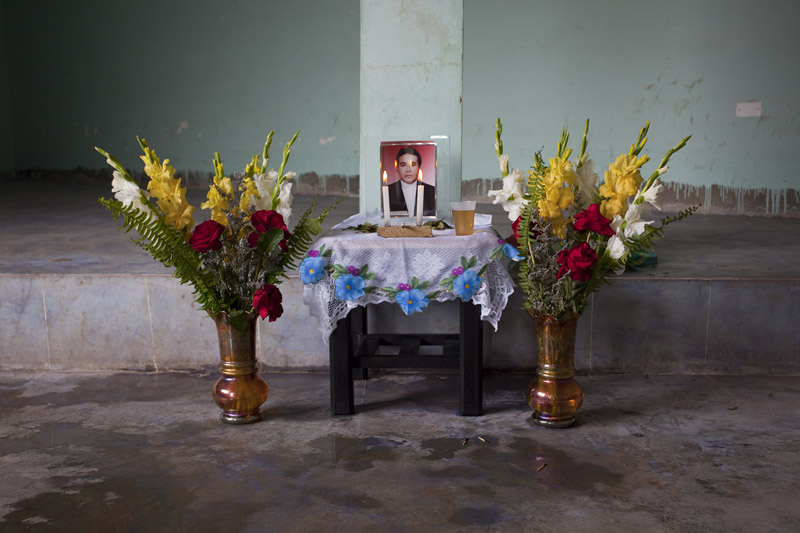
Carlos Sanchez Flores died a year ago, of gas in the mine, and there was going to be a big party. "It is because his soul has gone lightly, now," explains Marlene. In a turquoise, scrubbed room, we sat along the walls and received his mother and sisters, who walked around handing out cigarettes and distributing palm-fulls of coca leaves. A picture of Carlos along with all necessary libations plus candles stood at one end of the room and his mother sat by it, smoking, backlit by the engraved windows, and proclaimed definitively through the fog, "Drink!"

Don Juan, cat-like, exhaled at me, "Come back at 5. We will dance."

In the evening, the family had changed out of their black grieving clothing, which they had worn all year, and sat in a line against the wall with confetti in their hair, receiving guests. Guests came, kissed them on each cheek and pinned bills on the lapels and scarves of chosen members. Speakers as big as dog houses were piled up on both sides of the room and a live band recreated songs that would have sounded much better had they been played from a CD.

Drinks were first brought out on little fish trays; each tray contained a rum mixed drink, a sangani glass and two small shots of 96% alcohol mixed with something. Then waiters made their rounds with beer. Then more fish trays. Then large silver trays of just shots with another waiter trailing behind with a tray to deposit empties. Mother and sisters walked around restlessly, foreheads wrinkled with worry, waving both hands palms up, as if soliciting louder applause, and pleading, "Drink, drink!" Bottles appeared and their owners, too, made rounds distributing shots, waiting for you to take yours before ambling along. "I am sick," I tried to explain. "This is 96% alcohol. It will cure you," they insisted.

The dancing was getting sloppier and sloppier and I sat through a 15 minute "conversation" about Arnold Schwarzenegger; the only reason I knew it was still about Schwarzenegger was because the monologuer paused intermittently and slurred out, "Schwaaaaaaarzeneggerrrrr, you knoooow him?" as clearly as he could before continuing on with it. When I started getting aggravated, Johnny, ever helpful, leaned over and said, "Here, one must get along with everyone."

Carlos, I'm told, was rich and also powerful within the mine. The group of which he was the boss, The Sanchez, was the same one that the other Carlos worked in. Three other men, too, died last year from the same group and it disbanded, fearing the ominous (and carried out) deaths of fellow miners. The deaths, some say, were inevitable. With mineral prices at record highs in decades, the miners were working the veins 24-hours a day - day and night shifts - and drinking heavily (see above) in their off time. The mine never ventilated, allowing gas to accumulate, and their bodies never rested, lessening any chance of withstanding an onslaught of gas. Too, The Sanchez worked deep down, aggravating all of the above conditions until they fulfilled fatally, four times over.

There were no speeches and little mention of why we were there. There was a lot of drinking and dancing and then, again in our seats lining the turquoise walls, we ate pig and potatoes with our fingers from overloaded bowls while discussing sports.

"Asi es la mineria," Don Juan had said when he led me away that morning, which seemed melancholy, at best. But Johnny, drunk in a house discotheque later that night, explained: "I do not cry always (though his eyes were moist under the black lights), but here, it hurts very much," he said, pointing to his heart and making a movement with his hands as if his heart was vomiting. Then he grabbed me and we danced a strange stomping dance to a song from Oruro.